“If you could do anything in the entire world that served a purpose, what would yours be?”
Renee Rausch remembers asking this to her son, Tristan Berg, some three years ago.
The Iowans—who describe their relationship as “really, really close”—were sharing one of many long car rides to Minnesota’s Mayo Clinic. Rausch was managing significant health issues; Berg wasn’t exactly satisfied with his job. Life seemed short, she says.
Berg’s response to her query: “I want to make guitars for people.”
And literally so: instruments that are actually made for their players.
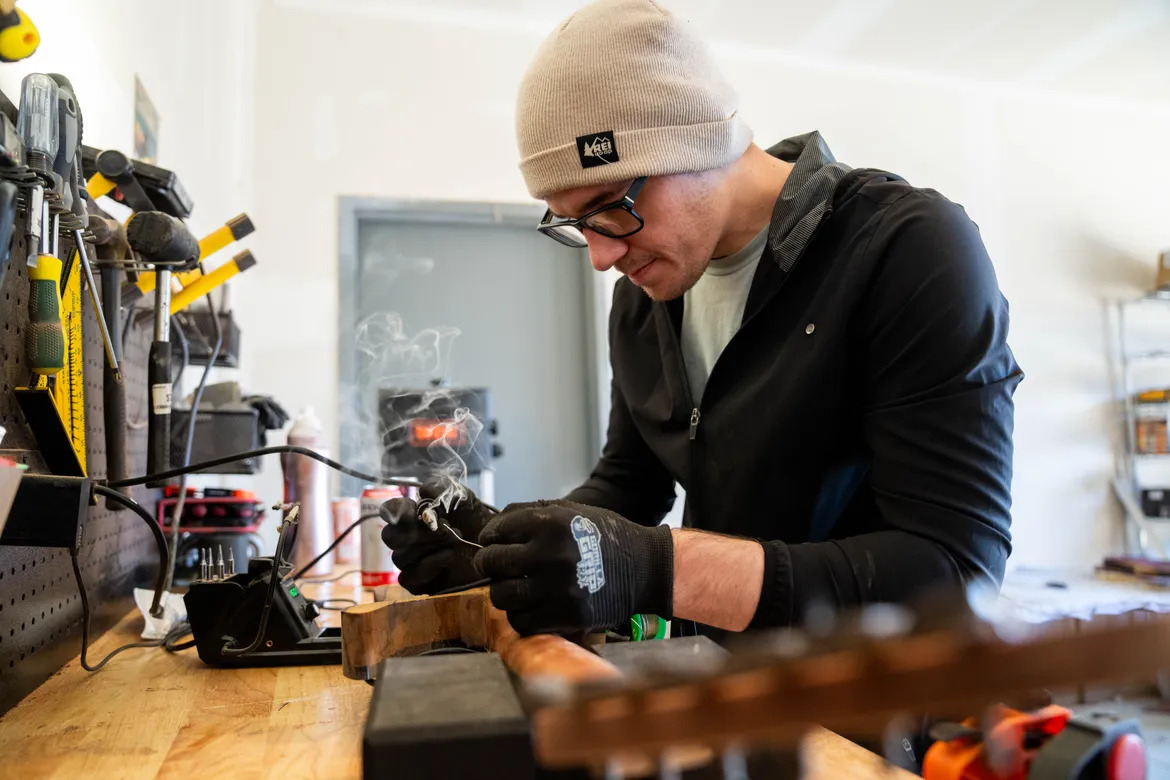
The duo started NVision Guitars out of their Ankeny garages. It’s a small company making guitars with custom-built accessibility features.

This might (and does) mean tactile dots along the guitar neck for blind players. Or different instrument weights, lengths, woods, and shapes to fit an array of bodies, wants, and needs. Guitars are shaped with mobility aids in mind. There’s custom fretboard spacing, and tone and volume knobs feel distinctly different.
NVision ships out 3D miniatures for folks to select which base model they’d like. Each is fully customizable from there. People can even send in their existing guitars, banjos, or ukeleles for Berg to better outfit.
“We start with the individual and then build around what different barriers that they face with the instrument. So sometimes it can be just that they need a lighter-weight instrument because they have fatigue,” says Berg, who grew up playing and tinkering with guitars. He learned to make his own with the help of local luthiers and YouTube videos.
“How can we create one that is more successful, that brings better quality of life?” He adds. “It’s a guitar that makes you a guitar player that fits your needs.”


The duo is working to normalize that customization. Everyone plays the guitar differently, they say. NVision’s builds can aid folks with chronic pain, arthritis, Parkinson’s, and so much more.
“It’s not just a solution for one person,” Berg says. “It’s the individual solution for that person, but then others can see that and see how it would benefit them as well.”
Rausch, who handles NVision’s marketing and communications, takes scraps from the building process. She reuses the wood to create unique guitar picks—many with accessible holes or grip assists in mind—and pieces of original art.
“So many times we’re trying to create things that the world would like, and then it inhibits our creativity. Instead, I think it’s important to create something that you love and then share it because then I think there’s more freedom to design something new in the world,” Rausch says, crediting her son.
“He’s created something that’s beautiful to him, and then he shares it with the world.”